tabs

Showing posts with label writing. Show all posts

Friday, January 30, 2015

Double-Entry Journal Responses & Padlet

I have been reading aloud two amazing books to tie in Social Studies, Reading, and Writing this unit: A Friendship for Today by Patricia McKissack and The Watsons Go to Birmingham - 1963 by Christopher Paul Curtis. Our discussions have been mainly about the civil rights time period because of the books, but students will be tackling the Constitution, the Bill of Rights, and a lot about Missouri!

The really awesome thing about A Friendship for Today (and totally engaged students right away!) is that the story takes place in our very own neighborhood! Patricia McKissack attended Robinson as one of the very first African American students integrating into a public school and writes about an African American girl attending "Robertson" in "Kirkland, Missouri" in 1954, after the decision of Brown v. Board of Education of Topeka banned racial segregation in public schools. Rosemary befriends a white girl who was her sworn enemy before she came to Robertson simply due to the differences of their skin color.

The Watsons Go to Birmingham - 1963 is about an African American family living in Flint, Michigan making the trek to Birmingham, Alabama during the crucial time of the civil rights movement, especially in the South. Students are learning about the unrest that occurred and how African Americans struggled for basic human rights. This book has been bringing about an open discussion of our rights and how the times have changed...or have they?

As I read aloud, students are taking notes in their reading notebooks with a double-entry journal response. The anchor chart we made last semester looks like this:

Once I finish reading aloud a chapter, students are asked questions that relate to that week's skill/strategy. When we first began answering these questions, students were writing incomplete sentences and very short responses. We then had a writing mini-lesson of revising and editing with the use of colors. [We've had to have many mini-lessons about nouns, verbs, and adjectives...more on that in a later post!] We use yellow to highlight the first word of our sentences [to add variety in our sentence starters], blue for verbs, and pink for adjectives. Students have noticed a growth in their responses, both in length and in thoughtfulness as we have continued to monitor what we write.
A sample of a student's writing to the question found on the label at the top of the picture.
Although writing in our individual notebooks is a great way to guide our thinking, it oftentimes is thought of as a private thing. So sometimes, students don't feel that they are kept accountable to their writing and their responses to the text. My teammate introduced me to padlet, a great way to view real-time responses. I placed some of the questions on padlet and students were able to see that their responses were going to be viewed by everyone in the room. It was a great way to be accountable for their writing and have a rich discussion afterward about the thoughts that were displayed.

Prior to the discussion, students had to read everyone's comments and then find one that they agreed with or disagreed with. Students had to provide evidence from the text or their own schema as to why they agreed or disagreed. What a great way to have a discussion while working on our skills of citing evidence and providing support!

Students have been enjoying this unit, as we have been learning about issues of social justice and the basic human rights of all. We hope to become citizens who respect the rights of all, within and outside the four walls of our classroom!

Thursday, October 24, 2013

Narrative Writing

I really need to do a better job of blogging while we are working on these things and not as an afterthought. :) But here is what we worked on during first quarter in writing! We worked really hard on learning what a narrative is and how writers write them.

In the beginning, students had a difficult time generating a narrative story. You can think of people, times [first, last, aha moments], places, and feelings of small moment stories. We also learned that writers live differently, by making observations, jotting down quotes or song lyrics that really make them think, or reading stories from authors as mentor texts and figuring out what they did to make their stories captivate us.

Once students got writing, we made an anchor chart to help us raise the level of our narrative writing. Some suggestions that were provided to students were: 

We also had to review the structure of a story, which will come in handy in our next reading unit!

Sometimes, students got stuck even before the story took off! We had to review how we might start our pieces without stressing out too much.

As we began revising and editing our pieces, we had to reorganize our sentences or thoughts so that it flowed and the audience would be able to completely follow the storyline.

AND, our stories would not have been revised without the help of a writing partner. They were the ones who listened to our drafts and provided feedback so that we could continue to grow as a writer. But before we could work with a partner, we had to make sure we had some strategies to help us be an effective partner!

Monday, October 14, 2013

Christmas in September

Yes, I know it's October. Yes, I know my post will be about what happened in my classroom in September. But trust me, it's been a crazy few weeks, and...honestly, I kind of forgot about this one.

But yes, we had Christmas in September in Room 201! Let me catch you up on the details...

In fifth grade, our team of teachers learned what it means to be a writer. (I am actually not a writer. Our team member, Mrs. Bearden, is a fabulous writer...so I am learning from her!) We handed out practice notebooks at the beginning of the school year. These were to help us learn more about what it meant to keep a writer's notebook and practice before we got our official composition notebooks. We learned how to make observations just by watching people. Seriously, it sounds creepy, but we are not at all trying to be! We even went outside during first grade's recess and just watched and wrote what we saw and heard on the playground. We learned how to look through magazines to find catchy titles or interesting captions or thought-provoking pictures to help us think about our own story ideas. We also brought in our own photographs from home to remind ourselves of small moments with family members and/or friends. Students also learned that quotes can be a great way to spark a thought or a story idea. These are only some of the ways that writers keep a notebook! And they have their writer's notebooks with them because we often forget what we see or what we hear. So we jot it as soon as a thought enters our mind! We even live differently now that we're writers!

I went for a long run while training for my half-marathon and could not believe my eyes when I saw:
I made my husband stop so that I could take this picture with my phone. I just had to take a picture so that I could put it in my writer's notebook and write about the experience! Ew, gross!

Now, we had been practicing in our small notebooks for quite some time. The question would be asked, "When are we getting our real notebooks?" And the answer would be given, "Not until you EARN them!" Well, the time came in September...


On an unsuspecting day, students arrived at school and found 25 gifts wrapped in wrapping paper sitting on my desk. "What's inside?!?!" Lo and behold! When they unwrapped their gifts, they found their composition notebooks! Such excitement and joy entered the hearts of these writers. We were now official writers with our new writer's notebooks!

Students have since been collecting ideas in their notebooks. They have been writing their narrative stories, whether based on true small moments or made-up ones. We've published our stories and will be finishing up this fabulous unit this week. We can't wait for what's in store for us and our writer's notebook this year!

Thursday, March 28, 2013

We are publishers of nonfiction!

What do you remember about your writing units in elementary school? I remember being taught that all of my papers had to be written in five paragraphs: introductory paragraphs, three main paragraphs for the body, and a concluding paragraph. There was the sandwich anchor chart and the umbrella anchor chart, and of course each paragraph needed the famous transition words such as "first of all" and "in conclusion." How booooooooooring.

In order to introduce writing a well-researched expository paper, we first began by exploring topics that were interesting to us. Some students chose ideas such as hurricanes, chocolate, Bigfoot, Cleopatra, optical illusions, and so forth. Students were curious about so many different topics! With each topic, we wrote down several questions that we would want answered. "How is chocolate made?" or "How do optical illusions work?" We narrowed our lists down to our favorite two or three topics and went into the Instructional Research [IR] Room in our library to start looking for valid resources. With the questions in hand, students began looking for answers. As they gathered information, they wrote down facts on a notecard, one notecard per fact, with the resource's bibliography contents on the back so that they could cite these sources correctly later in their published piece. Once students had gathered enough information, they sorted their notecards into categories for their paragraphs and began writing, revising, and editing, until finally they were able to put together a final copy!

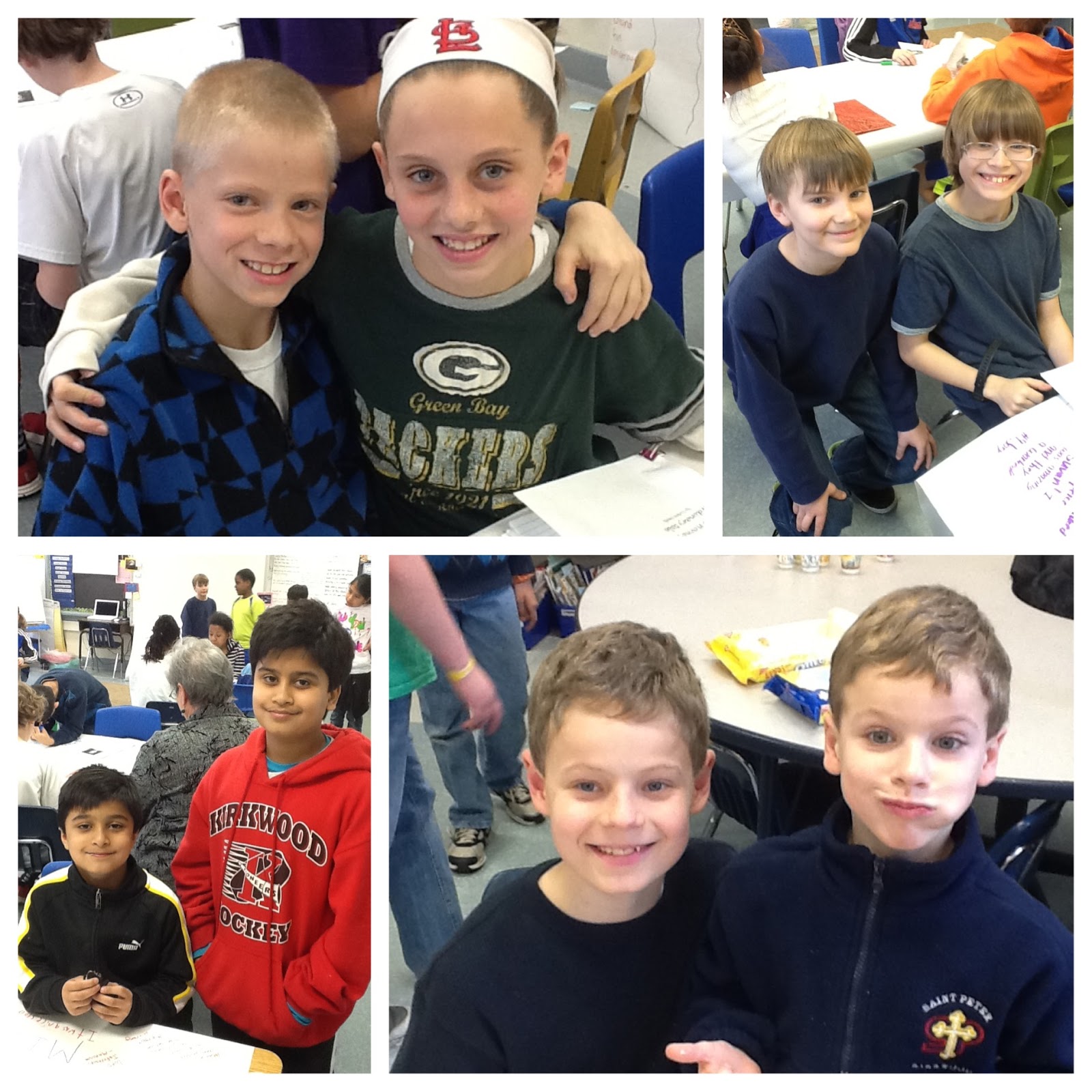
Honestly, this was my favorite writing unit thus far. Not just because students were highly engaged in what they were researching and writing about, but because of our final event. We had a publishing party where we invited special guests to come and read our pieces! We sent out letters to teachers, staff, siblings in the building, and other students we had relationships with. We set our published pieces on our desks and had a gallery walk, leaving comments on butcher paper that was set underneath.

Kudos to our fabulous writers for writing such wonderful and informative pieces!