tabs

Showing posts with label reading. Show all posts

Friday, January 30, 2015

Double-Entry Journal Responses & Padlet

I have been reading aloud two amazing books to tie in Social Studies, Reading, and Writing this unit: A Friendship for Today by Patricia McKissack and The Watsons Go to Birmingham - 1963 by Christopher Paul Curtis. Our discussions have been mainly about the civil rights time period because of the books, but students will be tackling the Constitution, the Bill of Rights, and a lot about Missouri!

The really awesome thing about A Friendship for Today (and totally engaged students right away!) is that the story takes place in our very own neighborhood! Patricia McKissack attended Robinson as one of the very first African American students integrating into a public school and writes about an African American girl attending "Robertson" in "Kirkland, Missouri" in 1954, after the decision of Brown v. Board of Education of Topeka banned racial segregation in public schools. Rosemary befriends a white girl who was her sworn enemy before she came to Robertson simply due to the differences of their skin color.

The Watsons Go to Birmingham - 1963 is about an African American family living in Flint, Michigan making the trek to Birmingham, Alabama during the crucial time of the civil rights movement, especially in the South. Students are learning about the unrest that occurred and how African Americans struggled for basic human rights. This book has been bringing about an open discussion of our rights and how the times have changed...or have they?

As I read aloud, students are taking notes in their reading notebooks with a double-entry journal response. The anchor chart we made last semester looks like this:

Once I finish reading aloud a chapter, students are asked questions that relate to that week's skill/strategy. When we first began answering these questions, students were writing incomplete sentences and very short responses. We then had a writing mini-lesson of revising and editing with the use of colors. [We've had to have many mini-lessons about nouns, verbs, and adjectives...more on that in a later post!] We use yellow to highlight the first word of our sentences [to add variety in our sentence starters], blue for verbs, and pink for adjectives. Students have noticed a growth in their responses, both in length and in thoughtfulness as we have continued to monitor what we write.
A sample of a student's writing to the question found on the label at the top of the picture.
Although writing in our individual notebooks is a great way to guide our thinking, it oftentimes is thought of as a private thing. So sometimes, students don't feel that they are kept accountable to their writing and their responses to the text. My teammate introduced me to padlet, a great way to view real-time responses. I placed some of the questions on padlet and students were able to see that their responses were going to be viewed by everyone in the room. It was a great way to be accountable for their writing and have a rich discussion afterward about the thoughts that were displayed.

Prior to the discussion, students had to read everyone's comments and then find one that they agreed with or disagreed with. Students had to provide evidence from the text or their own schema as to why they agreed or disagreed. What a great way to have a discussion while working on our skills of citing evidence and providing support!

Students have been enjoying this unit, as we have been learning about issues of social justice and the basic human rights of all. We hope to become citizens who respect the rights of all, within and outside the four walls of our classroom!

Tuesday, November 19, 2013

Don't Judge a Book by its Cover

I love introducing new books to my students. Especially since our school librarian introduced this awesome way of teaching kids how to pick books based on the words inside and not on its cover. It's amazing how often we judge a book by its cover, no?

Mrs. M introduced the read around to our class. She found wonderful books that would captivate readers and placed two books in each spot around the tables. Students were given four minutes to get a glimpse into both of the books and if students were interested in reading the book, they made note of the title.

After many rounds, students were then given the opportunity to voice their opinions about which books to place on the book club list. We had twenty titles go up on the board, but were able to narrow it down to twelve books. The next day, I read a brief synopsis of each book and asked students to provide me with their top three choices. As I tried to fiddle around with the groups and its members while trying to provide students with their first choices, they wouldn't stop asking me if I knew the books they would read! Eager beavers!

We are reading these books in our book clubs...have you read them?
  • Found by Margaret Peterson Haddix
  • The Hypnotists by Gordon Korman
  • The Journal of Scott Pendleton Collins by Walter Dean Myers
  • The One and Only Ivan by Katherine Applegate
  • Wild Life by Cynthia DeFelice
  • Word Eater by Mary Amato

What do you think about the process of choosing these books? Do you do something similar or is there another process that I could learn from?

But before we began our book clubs, my students had to learn some very valuable lessons in order to work in groups effectively and collaboratively. We really had to target some social skills because I had noticed that some skills needed some improvement. Here are the skills we practiced, in the order we practiced them!

These skills are pretty important to have when working in a group, especially when the group isn't formulated by friendships. We were able to practice these skills in non-risk discussions, such as having a conversation about our favorite movies, books, candy, etc... (This strategy is taken out of Harvey Daniels' Mini-Lessons for Literature Circles.)

Students will be in charge of creating their group's schedule of meetings and how many pages of reading will be due at each meeting. We have had one meeting already, having discussed the first chapter or first few pages in a written conversation! Hopefully, students will also notice the signposts that were taught to help them understand plot, theme, characters, etc... in a more meaningful way!

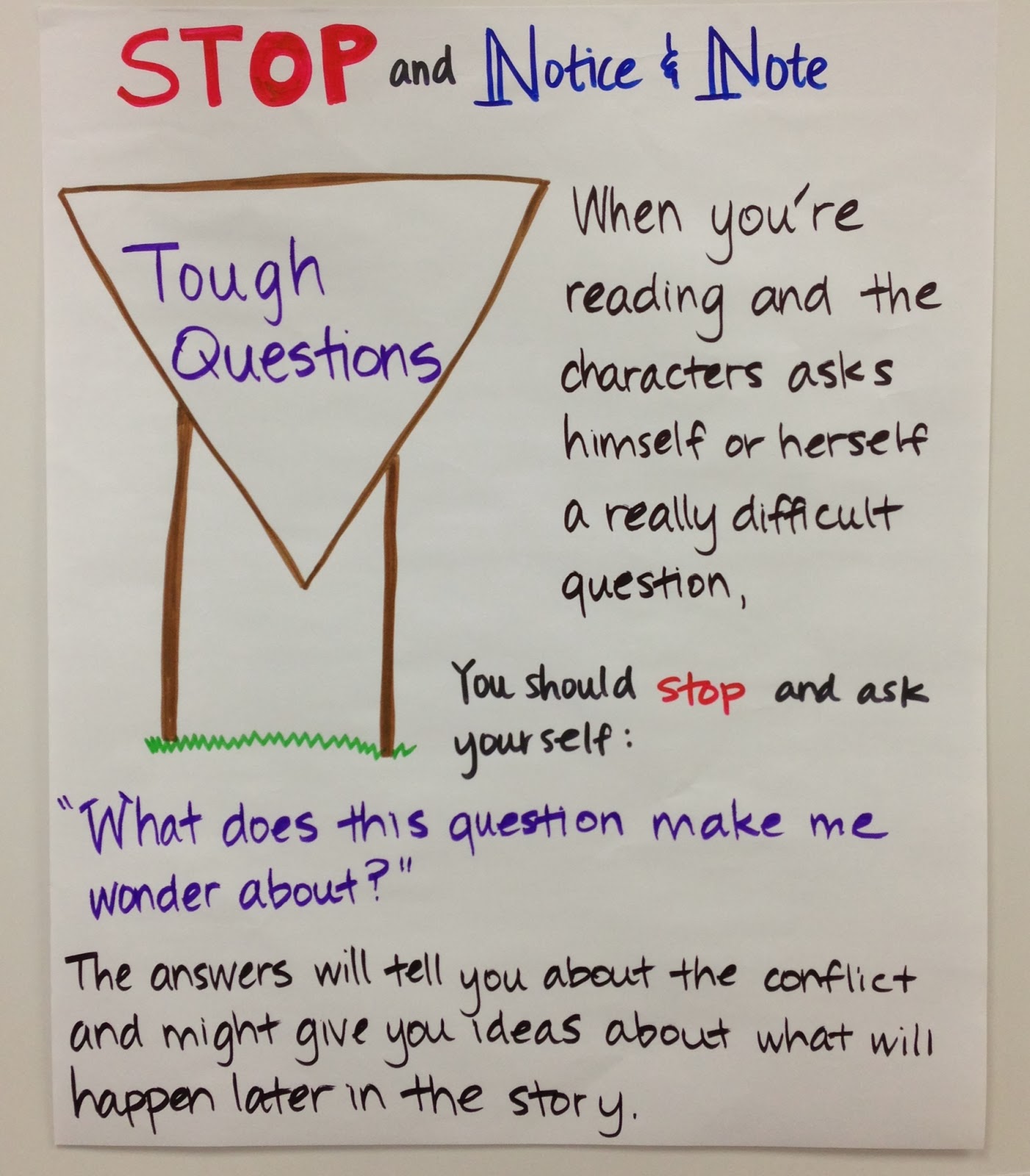
Stop! Notice & Note

Over the summer, I attended a Common Core conference with Understanding by Design guru, Grant Wiggins. (He is reallllllly smart! I wish I could have a conversation with him one-on-one and pick his brain!) One of the sessions I attended was about how to get students better at close reading and the speaker mentioned a book by Kylene Beers and Robert Probst, Notice & Note. The book was ordered and waiting on the shelf to be read! Seriously, it was probably fifth on my to-read list this summer and I finally got to it a few weeks ago. I wish I had read it sooner because I am gobbling up these signposts!

Before introducing these signposts, we started studying the theory of a character to help start us off in the right direction.

Here are the signposts that I made to hang around the classroom for students to see and use throughout the year!

We have been using these signposts in our read alouds and it is really causing us to think in a more meaningful way! Students' responses are really helping us make better predictions and inferences, and we are learning to comprehend in a deeper way than before!

Do you use these signposts in your classroom? Parents, have you seen a difference in the way that our students are connecting with a book?

Thursday, October 17, 2013

Challenge Accepted!

Here it is: The 35-Book Challenge. Well, I'd like to think that it's something that students are voluntarily choosing to do, but let's face it...I expect my students to accept. :)

With the Common Core State Standards challenging teachers to be more intentional and purposeful, our fifth grade team is trying to push students outside of their reading comfort zone. Many students, even adults, read what they are comfortable at reading. But let's face it, we should all be reading fiction and nonfiction and have strategies/tools to help us comprehend both types of texts!

So, with the help from Fountas & Pinnell (Genre Study: Teaching with Fiction and Nonfiction Books, 2012), I created the following documents to share with my students:

Students will have until the end of the year to accomplish the challenge, but I will be checking in with them to see how they are doing throughout the year. Parents, please help me by asking students how their book challenge is going! I hope that by doing this, students have a wider range of books to read from and eventually love!

I am also sharing a list of Mentor Texts that students can pull from if they are in need of some recommendations that are at 4th and 5th grade reading levels!

Challenge?!?! Challenge Accepted!

Friday, September 6, 2013

We are what?

We are READERS!

One year in Chicago, I received a Boundless Readers grant and having received this grant, I was given the opportunity to learn from some of the most amazing teachers in the district. I was focused on how we can get students to become better readers in one of the professional development sessions. One of the many take-aways from this session was this ever-changing anchor chart:

It provides the whole class with a number of suggestions if they ever run of books to read and it also gives me a quick assessment of what students are reading and how long they've been reading the same book. I hope that this is not a stagnant chart, but one that will be used to its fullest capacity!

Speaking of being readers...we tracked our reading stamina the first eight days of school. Here is what we saw:

We started reading with 22 minutes the very first day of school, without any interruptions, talking, getting up, etc... We had a hiccup the second day, but was able to learn from our mistakes and ended up reading for a total of 62 minutes the last day (not shown on graph)! Whoa, we definitely are or going to be readers in 5th grade!

Not only did we talk about being able to read for a long period of time, but we also talked about having the right fit book. We did an activity where we hid one of our shoes and someone else found it and...tried it on! Guess what? We don't all have the same size feet! Some shoes were too small, some shoes were too big, and some shoes really smelled! This demonstration helped us understand that there are books that are not the right fit for us and we have to find the books that match our reading levels!

Wednesday, April 3, 2013

We are 1:1!

WE ARE 1:1 WITH IPAD MINIS!

We have been for almost a week now and it has already revolutionized our teaching! Students at first needed to follow an intense instructional session before actually using them, but we survived some of the issues that occurred with a great learning mentality!
The students and I have already learned to create and curate a presentation on animal adaptations on the iPad using the Keynote app. We are also learning how to collaborate with one another as we use the Google drive and other apps, generating a culture of enthusiastic learning in Room 204!
 Students using the iPad to write about reading using a Google doc.
Students taking notes on the Notes app while watching a science video and presenting their animal adaptations Keynote.

So, families of Room 204, before students can bring home their iPads, they need: 1) You to sign the iPad User Agreement & 2) Students must answer the questions in a comment to Mrs. Sisul's blog after watching the digital citizenship video! If you're just a visitor to my blog, please feel free to read our principal's blog about how our district got started with the 1:1 iPad scout! I'd also love some feedback about how you use technology in your classroom!