tabs

Showing posts with label science. Show all posts

Tuesday, September 16, 2014

Force and Motion

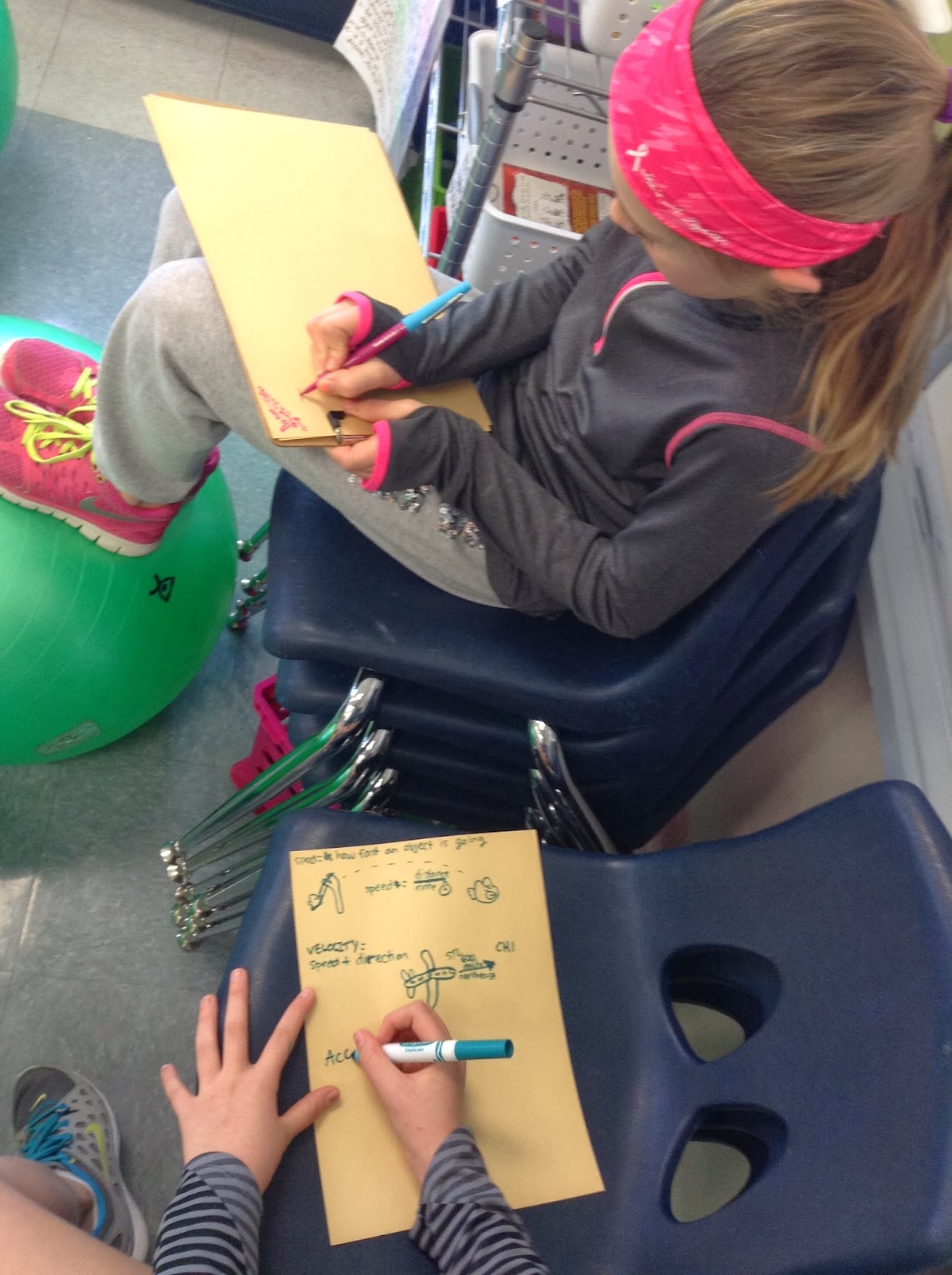
We began our science curriculum with a force and motion unit. After attending STEM TQ this summer, a two-week long teacher workshop involving STEM (science, technology, engineering, mathematics) practices, I was really motivated to bring a lot of the things I learned into the classroom. One way of doing that was to bring a lot of design challenges where students are designing, building, engineering, and so forth.

This unit began with an iSlide experiment, learning a lot about push and pull, as well as an experiment involving ramps, different surfaces, and toy cars to determine speed and how the different surface types affect the motion of the toy car.

We have since then moved on to one of our design challenges, designing a balloon car. Each group could only "spend" $15 on supplies and had two days to create a design and execute the plan.


Many students planned and designed and quickly learned that their balloon cars failed. Only three out of six balloon cars moved a distance of more than zero inches. Unfortunately, we did have to stop our design challenge time so that we could discuss (and revisit) our norms of collaboration and teamwork. Hopefully, our redesign of this challenge will prove to be more successful than 50%.

The first car moved a total of 155 inches, and it probably would have gone even further if it had not run into the chair (another lesson learned). However, this car definitely will need a redesign because it did not use a balloon! :)

The second and third balloon cars didn't go quite as far, but any movement was a success this round! Hopefully, these two groups will redesign their balloon cars for further movement!

Look for our redesigns in a following post!

Tuesday, May 6, 2014

Scigooooos?

We are totally having fun with Legos in Science!

We are actually dabbling in stop motion videos and I am so excited to share the most recent ones that they will be presenting tomorrow. We are not professionals (yet) at making stop motion videos, but we are learning quite a bit!

The question students had to research prior to creating a presentation was:

Is life sustainable on other planets? (Could life be sustainable on other planets?)

Students had to research (in teams) the planet that was chosen at random for them (I love the random team generator website we use for almost everything!). They were to find out if life was sustainable on their planet and find a way to present their findings. Of course, most of the students chose to make a stop motion video!


Here are some of the videos that my students created today!


Thursday, February 6, 2014

Marble Mazes

My wonderful fifth graders plunged into a GLAD (Guided Language Acquisition Design) Force & Motion unit where everything science was embedded with literacy! Students read about force and motion while writing about force motion while speaking about force and motion and listening about force and motion! Phew! That's a lot of force and motion.


Then we came to the week everyone was waiting for: Marble Mazes via Simple Machines! The task was to design and build a marble maze using three of the six simple machines we were learning about. Students picked their partners and began the project by designing a model before building it. We brought in materials like toilet paper rolls, rubber bands, foam noodles, straws, cardboard (in various forms), and so forth.

Students had a whole week to imagine, innovate, and implement their designs! Here's a video that brings that week together with the students' marble maze runs at the end.


How do you let science grow in your classroom? We are looking for more science experiment/project ideas if you are willing to share! Drop a comment below! :)

Sunday, September 22, 2013

The Great Egg Drop!

In order to re-introduce (or introduce...) the scientific method to my students, I wanted to find a fun experiment that would get them thinking about all the steps. So I searched on Pinterest (yes, this is an addictive hobby...don't start unless you know what you're getting yourself into) and found the Great Egg Drop Experiment!

First, you have to ask a question. What do you want to know about? Why do you want to know it? The second step is to then research your question. Has anyone asked your question before? What can you find out about your topic? Third step in the scientific method is to form a hypothesis. We understood the term hypothesis as not only a guess, but an educated guess based on what we researched and what we know. After forming the hypothesis, you need to test your hypothesis by designing an experiment and recording the data. Once you've performed your experiment, you need to analyze your data. Did your data match your hypothesis? And finally, you need to draw conclusions about the results. What did you learn? Was your hypothesis correct? What questions do you have now?

Students worked in groups to determine the answer to this question: Is it possible to drop an egg from the second story without it breaking? Some students went home and thought about it while others asked family members, friends, and/or neighbors. Students collaborated with their teams to come up with the best way to drop a raw egg from the top of the stairs and keep it from breaking! And boy, was there a lot of sketching, trials (without the egg), and so forth.

We concluded that it was possible to drop an egg without it breaking, but not every group was able to come up with a protective solution. Watch the video to see what happened!


Wednesday, April 3, 2013

We are 1:1!

WE ARE 1:1 WITH IPAD MINIS!

We have been for almost a week now and it has already revolutionized our teaching! Students at first needed to follow an intense instructional session before actually using them, but we survived some of the issues that occurred with a great learning mentality!
The students and I have already learned to create and curate a presentation on animal adaptations on the iPad using the Keynote app. We are also learning how to collaborate with one another as we use the Google drive and other apps, generating a culture of enthusiastic learning in Room 204!
 Students using the iPad to write about reading using a Google doc.
Students taking notes on the Notes app while watching a science video and presenting their animal adaptations Keynote.

So, families of Room 204, before students can bring home their iPads, they need: 1) You to sign the iPad User Agreement & 2) Students must answer the questions in a comment to Mrs. Sisul's blog after watching the digital citizenship video! If you're just a visitor to my blog, please feel free to read our principal's blog about how our district got started with the 1:1 iPad scout! I'd also love some feedback about how you use technology in your classroom!

Monday, April 1, 2013

MAP: Plants

Plant Cycle 

Parts of a Plant

Plants Grow and Grow 

Plant Sound-Off

WebQuest

As we approached the end of our Science Living Systems unit, I wanted to incorporate what Jen was doing with her class. So, we wrapped up the GLAD [Guided Language Acquisition Design] portion of learning and applied all the information we acquired into the WebQuest Jen had created in one of her graduate courses in technology.

I already love teaching science because of the GLAD strategies I get to use, but the addition of the WebQuest has made my love for teaching science even greater! Why? Because this is what I saw:
As this was a partner project, I saw students using iPads to collaborate, research, and imagine an animal based on what they learned in terms of classification and dichotomous keys. They were creating a presentation using Keynote or ActivInspire, while brainstorming on paper and pencil and watching videos on BrainPop. I mean, there was some serious learning going on in here and the students were taking responsibility for it! I wish I had taken pictures of the final product instead of just the process because it was evident to me that the students had learned the knowledge and were able provide evidence of that learning.

How do you incorporate WebQuests or technology into your classroom? I'd also love to hear if you incorporate Project Based Learning because I'd love to learn how to do more of that!