tabs

Showing posts with label fifthgrade. Show all posts

Tuesday, May 6, 2014

Scigooooos?

We are totally having fun with Legos in Science!

We are actually dabbling in stop motion videos and I am so excited to share the most recent ones that they will be presenting tomorrow. We are not professionals (yet) at making stop motion videos, but we are learning quite a bit!

The question students had to research prior to creating a presentation was:

Is life sustainable on other planets? (Could life be sustainable on other planets?)

Students had to research (in teams) the planet that was chosen at random for them (I love the random team generator website we use for almost everything!). They were to find out if life was sustainable on their planet and find a way to present their findings. Of course, most of the students chose to make a stop motion video!


Here are some of the videos that my students created today!


Monday, April 28, 2014

Closing the Gap with Legos!

Back in March, I read an article that argued that we are losing the attention of male students in the classroom. As a few educators and I discussed this problem, an idea that surfaced was using Legos to provide opportunities for all students to engage in what we're learning. So I jumped on that idea and logged into Donors Choose and started writing a grant proposal.

Below is what I wrote to attract potential donors:
"How will you show GRIT today?" That's our school theme of this year (and quite possibly every year from now on). We are choosing to persevere every day, even when it's hard because that is the biggest predictor of success!
My students are from diverse backgrounds. They love to collaborate and challenge one another's thinking. Students in our school receive free and reduced lunch and have a plethora of issues poring into the classrooms, but the adults in our school make it about the successes of these children! They have a great potential to not just merely survive in the real world, but succeed and impact life on the outside of our building walls.
Have you heard about the gender gap? Did you know that our boys are losing interest in schools?!?! We make them sit down, read a book, respond (talk or write) to the book, and so forth. These are activities in which boys normally dislike! So why aren't they engaged in school, we ask?
I am asking for Legos so that our boys will have a chance to rip apart, build, design, create, demolish, recreate, and put in motion what they are learning. And I bet these Legos won't be interesting just to boys! All students can be engaged in their learning by doing! Kinesthetic learning is so important for young children!
Legos can open the doors to robotics, STEM (science, technology, engineering, math) projects, literacy, and so much more!
Students of all diverse backgrounds will have a chance to take apart, put together, create and/or recreate designs that will challenge their minds. They will have all kinds of options to demonstrate their learning: creating a Lego representation, making a stop-action movie with Legos, and so forth.
This project makes me excited because it has the capability to reach the learners who aren't always excited to be engaged with a book! Girls, boys, readers, non-readers, everyone!
This project was funded within a month! And when my students found out, they were excited...but the excitement was more apparent once they were able to use them for a free-create session!

Saturday, March 29, 2014

Math Journals!

Math has been a struggle this year. So as I thought about what my students needed, I thought about last year. What was I doing differently this year that might be affecting the learning?

And with that came an "AHA!" I wasn't using a math notebook as I normally do! So, even as late as we are in the year (Quarter 4 to be exact), I introduced math notebooks to my friends! On the left side of the page, we write down: 1) Learning Goal (before the lesson), 2) What I Know (before the lesson), 3) What I Learned (after the lesson), 4) Proof (after the lesson), and 5) Reflection (after the lesson).

The Proof is something that they have to prove based on what the lesson was that day. For example, "Show the differences between a polygon, a nonpolygon, and a regular polygon." Students would then have to either draw or write the differences between these three categories. Reflections will help students reflect on the process as well as some content!

Here are some student examples!

Hopefully taking notes and making foldables will help students remember the knowledge/skills learned!

Thursday, February 6, 2014

Marble Mazes

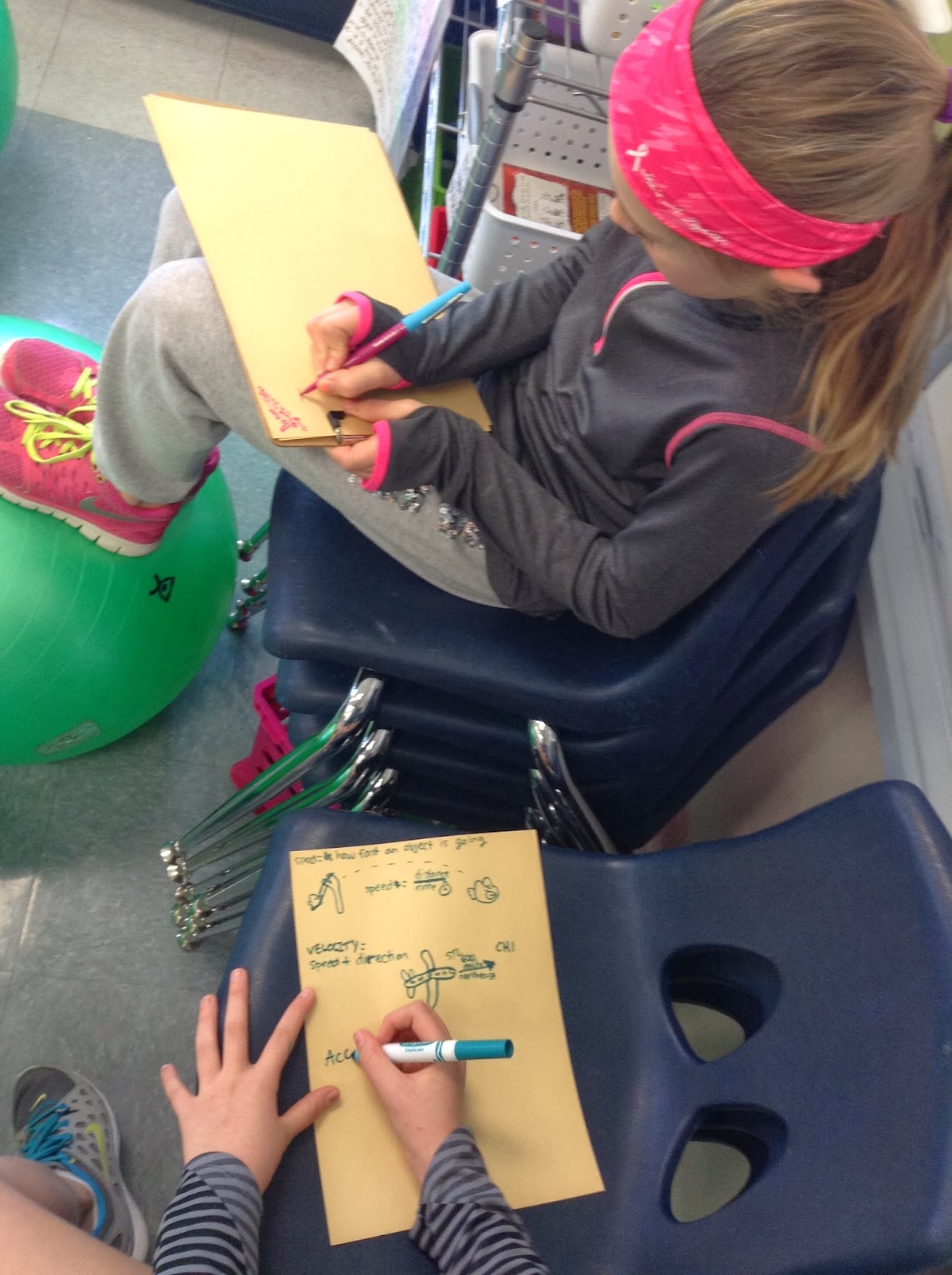
My wonderful fifth graders plunged into a GLAD (Guided Language Acquisition Design) Force & Motion unit where everything science was embedded with literacy! Students read about force and motion while writing about force motion while speaking about force and motion and listening about force and motion! Phew! That's a lot of force and motion.


Then we came to the week everyone was waiting for: Marble Mazes via Simple Machines! The task was to design and build a marble maze using three of the six simple machines we were learning about. Students picked their partners and began the project by designing a model before building it. We brought in materials like toilet paper rolls, rubber bands, foam noodles, straws, cardboard (in various forms), and so forth.

Students had a whole week to imagine, innovate, and implement their designs! Here's a video that brings that week together with the students' marble maze runs at the end.


How do you let science grow in your classroom? We are looking for more science experiment/project ideas if you are willing to share! Drop a comment below! :)

Tuesday, November 19, 2013

Don't Judge a Book by its Cover

I love introducing new books to my students. Especially since our school librarian introduced this awesome way of teaching kids how to pick books based on the words inside and not on its cover. It's amazing how often we judge a book by its cover, no?

Mrs. M introduced the read around to our class. She found wonderful books that would captivate readers and placed two books in each spot around the tables. Students were given four minutes to get a glimpse into both of the books and if students were interested in reading the book, they made note of the title.

After many rounds, students were then given the opportunity to voice their opinions about which books to place on the book club list. We had twenty titles go up on the board, but were able to narrow it down to twelve books. The next day, I read a brief synopsis of each book and asked students to provide me with their top three choices. As I tried to fiddle around with the groups and its members while trying to provide students with their first choices, they wouldn't stop asking me if I knew the books they would read! Eager beavers!

We are reading these books in our book clubs...have you read them?
  • Found by Margaret Peterson Haddix
  • The Hypnotists by Gordon Korman
  • The Journal of Scott Pendleton Collins by Walter Dean Myers
  • The One and Only Ivan by Katherine Applegate
  • Wild Life by Cynthia DeFelice
  • Word Eater by Mary Amato

What do you think about the process of choosing these books? Do you do something similar or is there another process that I could learn from?

But before we began our book clubs, my students had to learn some very valuable lessons in order to work in groups effectively and collaboratively. We really had to target some social skills because I had noticed that some skills needed some improvement. Here are the skills we practiced, in the order we practiced them!

These skills are pretty important to have when working in a group, especially when the group isn't formulated by friendships. We were able to practice these skills in non-risk discussions, such as having a conversation about our favorite movies, books, candy, etc... (This strategy is taken out of Harvey Daniels' Mini-Lessons for Literature Circles.)

Students will be in charge of creating their group's schedule of meetings and how many pages of reading will be due at each meeting. We have had one meeting already, having discussed the first chapter or first few pages in a written conversation! Hopefully, students will also notice the signposts that were taught to help them understand plot, theme, characters, etc... in a more meaningful way!

Thursday, October 24, 2013

The Best Buy

In June, I had an awesome opportunity to learn how to teach math from the incredible Kara Imm. She is a staff developer from Math in the City and taught middle school and high school math in her years as an educator. I could go on and on about how much I love learning from Kara and how she's changed the way I approach teaching math to fifth graders! However, I will spare you these details and talk about the math we did the past couple of days.

Before we dive into the math though, I'd just like to say that I had about twenty teachers from my district come into my room and observe my teaching and Kara's conferrals, as well as observe my students, so that we could do a whole lot of learning in our debrief. I was really excited about learning from the feedback of my colleague, but it wasn't until I started launching the lesson that I got really nervous. I mean, I saw the usual twenty-five faces of my students in anticipation of the lesson. But in addition to those lovely faces, I saw the eyes of twenty adults watching my every move. I'm prettttttty sure my face was flushed pink!

Anyway, enough about me! How about that math now? :)

Students were given this context to begin:

I noticed that Target and Babies 'R Us sold the same brand of baby food, but had different bargains. Target sold 12 jars of this brand of baby food for $15 while Babies 'R Us sold 20 jars of the same brand for $23.

I then informed students that I was trying to figure out which one was the better buy and sent them off to do the math.

Whoa, what an entrance into our fractions unit!

Here are some of the posters that students made to show their thinking:


Whoa, did you catch what some students were doing in the first poster? They dealt out the money amongst the jars in order to find the price of one. Did you catch a misconception in the second poster? Some students were able to do long division, but were unable to name out what the "R3" represented. What about the last poster? What do you notice here? They didn't have to start from the beginning once they found the price per unit at one store. They knew that they could compare the pricing of 20 jars at Target to the 20 jars at Babies 'R Us instead of finding the price per unit!

Trust me. This math isn't easy. I know I'm asking my students to do some hard work! But most of them are showing me what grit looks like in math and I am truly impressed! Keep it up, fifth grade rockstars!

Narrative Writing

I really need to do a better job of blogging while we are working on these things and not as an afterthought. :) But here is what we worked on during first quarter in writing! We worked really hard on learning what a narrative is and how writers write them.

In the beginning, students had a difficult time generating a narrative story. You can think of people, times [first, last, aha moments], places, and feelings of small moment stories. We also learned that writers live differently, by making observations, jotting down quotes or song lyrics that really make them think, or reading stories from authors as mentor texts and figuring out what they did to make their stories captivate us.

Once students got writing, we made an anchor chart to help us raise the level of our narrative writing. Some suggestions that were provided to students were: 

We also had to review the structure of a story, which will come in handy in our next reading unit!

Sometimes, students got stuck even before the story took off! We had to review how we might start our pieces without stressing out too much.

As we began revising and editing our pieces, we had to reorganize our sentences or thoughts so that it flowed and the audience would be able to completely follow the storyline.

AND, our stories would not have been revised without the help of a writing partner. They were the ones who listened to our drafts and provided feedback so that we could continue to grow as a writer. But before we could work with a partner, we had to make sure we had some strategies to help us be an effective partner!

Saturday, October 19, 2013

#1 Fan

I was invited by a few students to come and watch their soccer game today. I knew it'd be difficult on a Saturday to make it, but I really wanted to be there. I want my students to know that I support them in the four walls of our classroom, as well as outside of our classroom.

Last year, I was privileged to attend a soccer game, a basketball game, and a musical/play. I unfortunately missed out on a concert and a dance recital last year, but hopefully those students have forgiven me!

Today, I made it out to not only watch one student of mine play, but SEVEN students happened to be on the same team! One couldn't play due to a recovery, but even he came out to cheer on his team! And it was cold today! I thought I'd be okay in my vest, but I should have brought a sweatshirt or my winter jacket! Brr!


Unfortunately, today was not a winning game day, but it was so fun to go out and cheer for my students in a different way. Hopefully, they know how much I care about them and want them to succeed in all arenas of their life!

Here's to many more "games" that I hope you win!

Love,

Your #1 Fan

Thursday, October 17, 2013

Challenge Accepted!

Here it is: The 35-Book Challenge. Well, I'd like to think that it's something that students are voluntarily choosing to do, but let's face it...I expect my students to accept. :)

With the Common Core State Standards challenging teachers to be more intentional and purposeful, our fifth grade team is trying to push students outside of their reading comfort zone. Many students, even adults, read what they are comfortable at reading. But let's face it, we should all be reading fiction and nonfiction and have strategies/tools to help us comprehend both types of texts!

So, with the help from Fountas & Pinnell (Genre Study: Teaching with Fiction and Nonfiction Books, 2012), I created the following documents to share with my students:

Students will have until the end of the year to accomplish the challenge, but I will be checking in with them to see how they are doing throughout the year. Parents, please help me by asking students how their book challenge is going! I hope that by doing this, students have a wider range of books to read from and eventually love!

I am also sharing a list of Mentor Texts that students can pull from if they are in need of some recommendations that are at 4th and 5th grade reading levels!

Challenge?!?! Challenge Accepted!